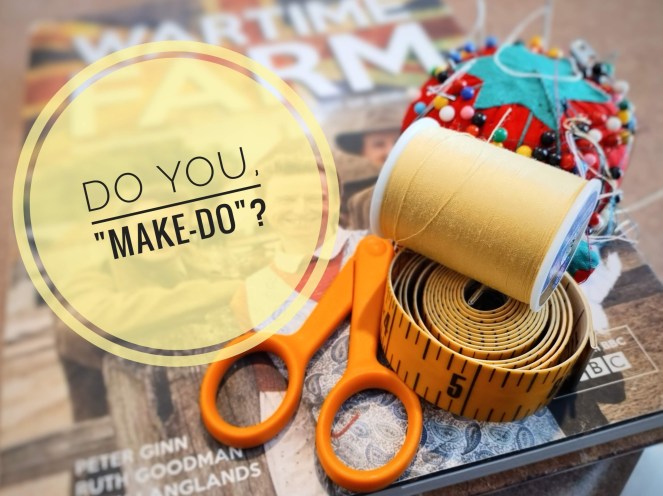
For the second time in several years, I’m re-watching the Wartime Farm, a BBC production from 2012. It follows the adventures of a team of three: historian Ruth Goodman, and archeologists Peter Ginn and Alex Langlands, as they recreate the conditions of a farm during World War Two, 1939-1945, in Britain. It is filmed on the beautiful Manor Farm, an historical park that has preserved much of late 1930s and early 40s living space and agriculture.
I’m always drawn to these historical recreations. A genre that became popular back in the late 1990s with the Victorian House and the 1940s House (my favorite), among other historical, time-travel “reality” shows. Though in some productions the internal drama of the participants predominated, the Wartime Farm definitely does not do so (and neither did the 1940s House for that matter, much to the credit of those participating).
Tough times can produce sterling qualities
My own college research was in the WW2 era, and I have been and remain fascinated with that time when so much was on the line. We live in a similar period, though cocooned in our material plenty, we often do not recognize that fact. My own grandparents spent their teen and young adult years navigating the Great Depression and the Second World War. It left an indelible impression on their lives and lifestyles. My maternal grandparents had a Victory-style garden nearly their whole lives, though, to be fair, they had grown up the children of homesteaders, so their subsistence lifestyle predates the 30s and 40s.
There was a great pulling-together and spirit of self-sacrifice, which ultimately showed many people that they were made of tougher stuff than they had assumed. There was strength in shared purpose, and the dangers of invasion and occupation brought on a sobriety that had been lost in the excesses of the 1920s.
Aside from the greater moral lessons of the war, what I really found practical from a Prudent Consumer perspective, is the concept of “making-do” that predominated WW2 government and popular, practical literature, and a principle featured in the Wartime Farm series. This was especially so for Britain, where, as an island, they were subject to greater privations than in the U.S. Making do with what you had before the war had to carry you through to the end of it (whenever that was), or until intrepid merchant boats could get through the German blockade at sea.
Old lessons, new applications
We’re feeling a bit of this now in the U.S., with increased interest rates and the need for new trade negotiations. A dynamic that is always rough seas at first until fruitful negotiations produce a fair reciprocity in international trade. Could we end up without the flow of endless material goods from China? Or at least a slower flow? Might we have to wait on U.S. production to ramp up and then pay a bit more for, one hopes, better quality? Possibly.
In either case, the premise of “make-do and mend” or “use what you have and repair items that you might otherwise have thrown out” were hallmarks of both the Great Depression and WW2. They served people well then, and can do so now.
Three takeaway principles
A framework for applying a “make-do and mend” mentality:
- Think before you spend. Ask the simple question: do I already have something that will serve the same purpose as the item I want to buy? If I do, and it needs a bit of mending or repair, can I accomplish that? If not, do I know someone who can? Can I learn the repair skill from YouTube or another person?
- Singularize, don’t duplicate. If you have an item in one color (aside from t-shirts), do you need the same thing in five tonally harmonizing hues? No, buy the neutral one first and it will match with more things.
- Learn the difference between “wants” and “needs.” You might also hear these referred to as “extras” and “basics.” You can get by on basics, groceries or otherwise, but you will become wasteful if you always purchase extras. You’ll also accrue debt.
I’m sure you can think of many other applications of “make-do and mend,” and it’s a great mental exercise to practice.
And remember, it can also apply to technology! If you’re feeling overwhelmed by the constant barrage of social media, you can “make-do” with less by cutting back on the sites and apps you participate in. Delete all but the most “basic” apps from your phone screen and notice how much less you feel tied to your device.
Let me know of any additional “make-do” ideas you’ve developed in the comments section!
Sources:
Wartime Farm: Rediscovering the Skills and Spirit of World War II, Peter Ginn, Ruth Goodman, Alex Langlands, Mitchell Beazley publishers, 2012.
Wartime Farm is presently streaming for free on Tubi, as of February 2025.

 The Prudent Consumer
Thank you for this message. I grew up ‘poor’ but always had the basics (necessary things). We did not have running water and I feel today-too much water is being wasted. When you need to carry the water in and carry it out-you use it wisely. We used a wood cook stove, which had all of the modern conveniences of today in one. It heated the kitchen on cold days, cooked the meals and kept them warm, baked all you needed in the oven. You had to know how to regulate the temperature and also needed to prepare the wood to burn. All necessary work, but that produced a joy in life that is missing today.
I have examples of my grandmother who raised 11 children (my mother was the oldest). My grandmother would take in ironing and sewing for extra money. She would get used clothing from neighbors and would take the clothing apart very carefully, saving the thread and then make clothes for her children. I have her diaries that I find very interesting is that she made do.
I raised 11 children and I was glad that I had learned how to live without many things. But we are a close knit family and my children are glad that they learned to work as they feel that is missing in many people they deal with today. Gardening and baking are also ways to have without spending a lot. Just work, which in turn can be very joyful. Picking the first ripe tomato is always a great joy to me as is taking a fresh baked loaf of bread from the oven.
I enjoy looking back to what my grandparents went through and all the changes that took place in their lives. I look back in my life and of all the changes that are taking place. Time is going too fast-and I fear of how our modern world is not improving our lives like so many think. I am so thankful that I know that God is in charge no matter what takes place and I look forward to Christ’s return. Thinking often of you and your family.
Clara Groenhoff
LikeLike