Do Your Homework

Barometers: Getting To Know A Valuable Device

With the winter weather we’ve been experiencing here on the central plains, watching the change in atmospheric pressure is an interesting and practical hobby.
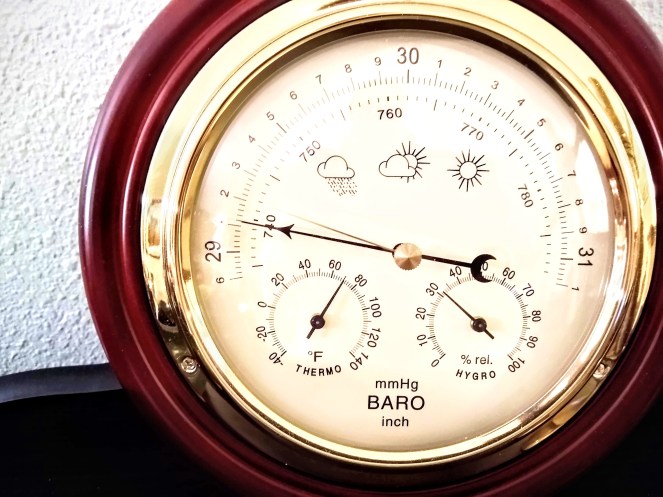
Photo: Amanda Stiver

I’ll admit, digital weather devices are as ubiquitous as the cell phone in your hand, and they are both useful and lifesaving.

Our personal experience was confirmation of this, when this last spring a derecho swept up from the south central plains at 100 mph, dragging a dust storm. A quick update on my smartphone alerted us to the severity of the storm and we were able to batten down the hatches and prevent more serious damage to life and limb.

And yet, on our dining room wall is a small round instrument the size of a salad plate. It’s a good, old fashioned aneroid barometer. The mechanism is in a sealed box containing a highly sensitive metal spring that expands or contracts as the air pressure squeezes or releases the box. The spring is attached to a dial that moves on a calibrated scale and shows a numerical measurement of the pressure reading.

Low pressure usually presupposes a storm, while higher pressure typically indicates clear weather. To take a reading you gently tap the glass (to make sure the spring is moving freely), read the air pressure number, then you turn a small gold dial and arm, which protrudes from the center of the glass, parallel with the internal pressure dial. Finally, you wait for some hours and take a reading again. If the pressure has moved, the internal dial will move and the external arm will indicate the previous pressure and the direction of movement, higher or lower, clearer or stormier.

Fun, right? I think so.

Now the why. What does a barometer have to do with a prudent consumer?

Several things…

  • When the power goes out. Digital devices are a great first line of defense for weather news, but a good non-digital backup can give additional peace of mind and remind us not to take the power grid for granted.
  • Aesthetics. A quality nautical-style barometer looks handsome on the wall alongside a keepsake clock, or other similar arrangement. What do aesthetics have to do with being a prudent consumer? Our physical environment shapes us more than we may realize, and choosing beautiful and quality items to adorn your home environment (always according to sound budgeting) is a way to uplift our outlook. They add value to our surroundings and remind us not to get caught in the trap of buying cheap junk, which is not prudent, usually breaks quickly and requires spending more in the long run than what is saved in the short run (I should know, I’ve been caught there more times than I like to admit). Dignity is both internal and external, our home environment can become a visual expression of how we think about ourselves.
  • Skills. Taking readings from an aneroid barometer is a skill set, and skill sets give us flexibility when facing challenges. This particular skill, employing a device that uses a physical mechanism to measure an atmospheric condition, which can help us understand the weather outside is good for our minds. It keeps us in touch with reality. In a philosophical sort of way, anything that reorients us to physical things, such as the weather, helps us to counteract the emotionally invasive influence of the digital, mostly non-reality based onslaught of social media and news. In short, it puts your head in a better place, just as gardening and other outdoor pursuits can do. A barometer can be a small reminder of that outdoor connection during the cold winter months.

Plus, my grandma had one on her wall and my mom remembers the excitement she felt as her brother took pressure readings and they anticipated a coming storm, like the tremendous Columbus Day storm of 1962. Little things can sometimes be the most important things!

Keep a shiny penny and a positive thought!

[If you would like your own device, this is the one we bought on Amazon (as of this writing we’re not an affiliate): barometer. We’ve found it dependable, and durable compared to some we’ve had in the past, and it is a very fine-looking piece (as seen in the photo above) for a wall display. ]

Sources: “Barometers” by Chris Woodford, Jul., 3, 2022 https://www.explainthatstuff.com/barometers.html
Preparedness

What to Do While Waiting for the Storm

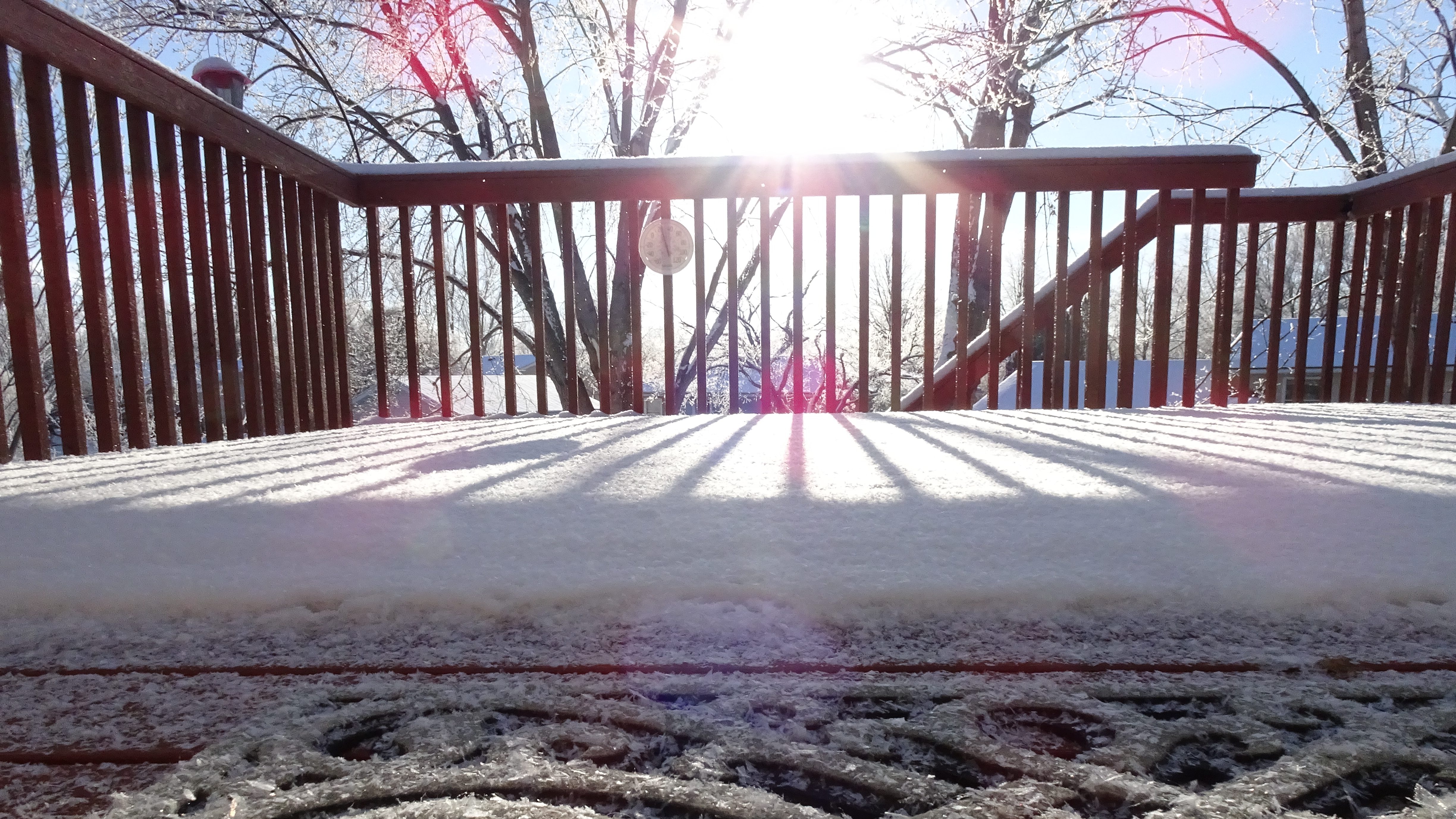
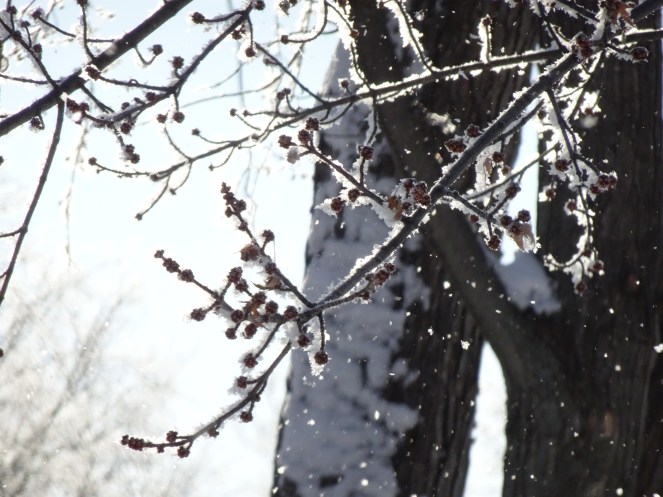
Here in the central plains a winter storm can mean “batten down the hatches, we’re in for it” or “nah, never mind…lots of wind, but no accumulation”. Often the weather forecast can’t even tell which it will be until the winter storm makes itself clear. Polar freeze? Or just a little blowy snow?

Photo: Amanda Stiver

This is a great time to take stock of what to do when you’re waiting for potentially nasty winter weather. In this age of digital weather apps we have heavy duty forewarning. A blessing compared to the days when folks had to gather weather data based on observation and maybe a thermometer or, if lucky, a barometer. Those predictions were sometimes surprisingly accurate, but radar makes it much easier for us. Sometimes too easy.

With an accurate weather forecast we can justify waiting till the last minute to stock up and prepare as compared to our ancestors who had to prepare all summer for the winter, no matter what the weather was going to be. This is a blessing and a curse. Do we procrastinate and become naïve about how well technology will function in extreme weather? Forewarned is forearmed, but we still have to do our part or forewarning just becomes foreboding.

Now to practical matters. What to do if a winter storm is bearing down on you?

Photo: Amanda Stiver
  1. Take stock. What’s in your fridge? In your freezer? Pantry? Do you have enough basics and a baseline supply of fresh foods to get you through a few days if the roads are impassable or, worst case, if the electricity goes out and you can’t cook in the way you normally do? Do you have adequate sources of protein and carbohydrates? These are the building blocks of heat in the body? Do you have a good supply of drinking water, if the pipes freeze?
  2. Check your heat and light sources. Do you have back-up? Either a generator, or kerosene oil heater, wood stove or other heating device? If so, do you have enough fuel, wood, oil, gas, propane or otherwise? A fuel-less heater isn’t much use. Also important, where will you heat food if the electricity goes out? A propane camp stove outside will do in a pinch, or even a gas barbecue, although you need to bundle up! (Don’t try to use either of these cookers in a house or under a roof!!) Do you have oil lamps, lanterns or LED light sources with adequate batteries or fuel to keep them lit? Also, check your stock of warm clothes and blankets. If you are without heat for a little while, bundle up to preserve warmth!
  3. Do you have a reasonable supply of essential nutritional supplements or medications? This is often an afterthought, so keep a running stock in the cupboard! We’re natural health types, so having the proper nutritional supplements, at least a month’s worth, is essential for some of our health needs. We order in advance because in our part of the central plains you can’t just pop into the local health food store (there isn’t one).
  4. Build a menu, add some fun and seize the adventure! When checking your supplies, take time to jot down a good pre-planned menu for emergencies and then be sure to have the components on hand. This takes the stress off, but it can also make lemonade out of lemons. Aside from simple dishes and maybe some soup mix, be sure to include hot cocoa and marshmallows. Or, if baking is your thing, have the proper supplies for a yummy gingerbread or cinnamon rolls. Then check your board games and other fun items. A movie night is great, but if the power is sketchy, board games or cards by candlelight can be an out-of-the-ordinary diversion. Maybe spend some time imagining what it was like for your forebearers who didn’t have electricity until the last century (that’s everyone). Life was very different, and required a lot of planning ahead. Family stories about the challenges and adventures of that time are a good thing to store up for events like these, just ask grand or great-grand parents! Shared trials can be, ironically, a good way to connect with family and others!
  5. Finally, schedule a trial run, check supplies and restock often! If you have heaters, lights, generators, and other devices that you have never used, take time (not during a storm) to test them, and learn how to use them safely and with ease! Below zero temperatures are not the time to be fiddling with a generator outside!

There are many other considerations when preparing for an approaching storm, and the list above is only a starting point. Here is a resource from the CDC that offers a winter storm preparation list for home and vehicle: https://www.cdc.gov/disasters/winter/beforestorm/preparehome.html

This resource from the American Red Cross has handy printouts to keep on file: https://www.redcross.org/get-help/how-to-prepare-for-emergencies/types-of-emergencies/winter-storm.html

Preparing ahead of time for challenges and difficulties is an essential quality of a prudent consumer. A day’s worth of preparation is a penny (or a life) saved in the long-run!

Keep a shiny penny and a positive thought!