I don’t know about you, but as much as I love the endless availability of recipes on the internet, sometimes I like to take a peek inside a traditional cookbook. In particular, those from the heyday of the Home Economics movement in the early 20th century contain some surprisingly handy nuggets.
So, what do they have to offer us now?
One feature that I love about cookbooks of this vintage are the extensive menu planning sections. I think we’ve lost this feature in many modern cookbooks, partly because our ability to buy books has increased and those who like to cook tend to collect many cookbooks (guilty, as charged) rather than just one comprehensive volume. Niche cookbooks tend to eschew menu planning because they stick to only one flavor or type of cuisine. Also, homemaking has been denigrated and women who are solely homemakers are not a majority, so cookbooks have shifted focus to quick meals and visual ideas, rather than systematic, comprehensive kitchen science and planning.
Practical buried treasure
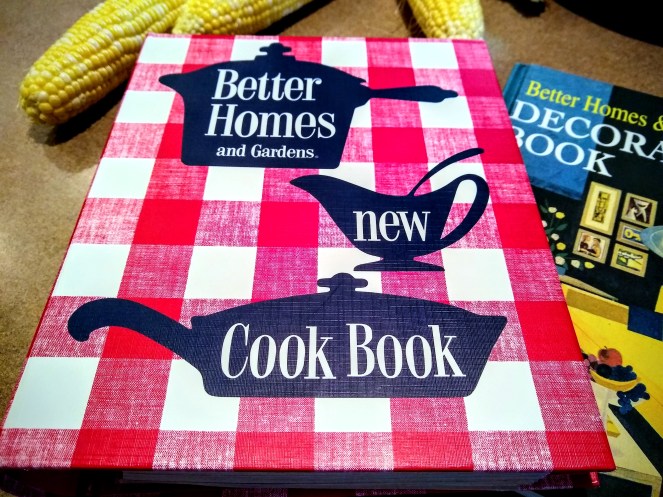
So, what does this meal planning feature look like in the 1953 Better Homes and Gardens New Cook Book?
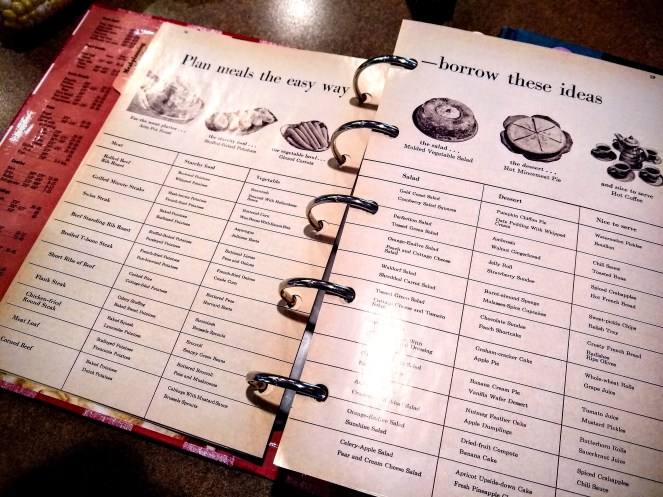
A very clever graph, looking a lot like what we would consider a spreadsheet page. On the left are the main dishes, mostly meat, then the following categories with two options each for starchy foods, vegetables, salad, dessert, and special extras called “nice to serve.”
There are about 18 or so pages of these menu ideas. They cover dinner, lunches, hearty breakfasts, and “oven meals”—where all dishes can be cooked in one oven, meals for large groups, and lunch-box meals. In addition are nutrition guidelines (which continue to have much to offer…i.e. eat your veggies!), food-storage, and directions for meal planning.
Let’s take a for-instance. From the menu spreadsheet, one of the “Meat” options is the familiar standard, Meat Loaf, in the accompanying “Starchy food” options are Scalloped Potatoes or Franconia Potatoes (browned, or roasted). From the “Vegetable” column are Buttered Broccoli and/or Peas and Mushrooms. Next is the “Salad” category, with a choice of Orange-Endive Salad or Sunshine Salad (a gelatine salad with pineapple, carrots and pecans). Finally, “Dessert” offers two options, Dried-fruit Compote or Banana Cake, and the “Nice to serve” column suggests Spiced Crabapples or Chili Sauce (for the meat loaf, presumably).
Nutrition
Here’s where the Home Economics movement hit its scientific peak in meal planning. If we take a look at the “Daily Food Plan” pages in the 1953 BH&G Cook Book we see where our sample meal fits right in. It calls for meat/poultry/fish once daily…so there’s our meatloaf. Next, we have the potatoes/veggies/fruits category, so check mark the potatoes and broccoli and/or peas in our menu plan.
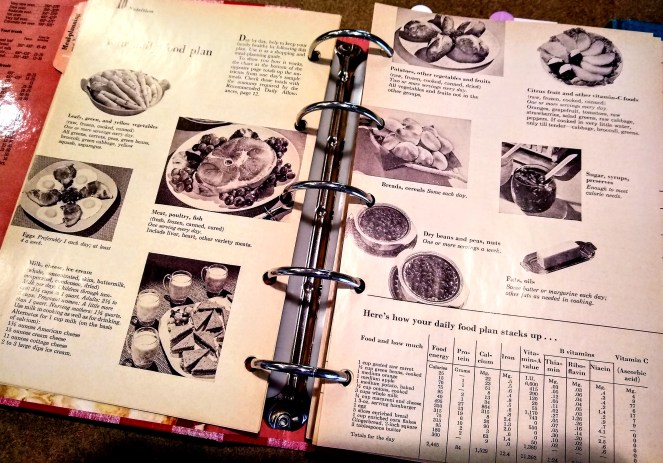
Our Sunshine Salad (remember the carrots and pineapple) and/or the Orange-Endive Salad, easily covers the citrus fruit/other Vitamin-C foods category. The carrots in the Sunshine Salad, and the endive in the Orange-Endive Salad could also cover the leafy/green and yellow vegetables requirement. The desserts will include some dairy, so there’s that, and sugar and oil, check and check. Bonus points for the “regularity” fiber in the Dried-fruit Compote dessert option.
A lot to think about, and somewhat complicated to plan for, which is the genius of the meal planning spreadsheets!
Oh, what a loss when we lost Home Ec
The Home Economics movement began in the last half of the 19th century and was in its stride until the middle of the 20th century, when politics, space-race science, women’s liberation movements, and other policies voided funding for home economics departments in colleges and high schools alike. Which is really a shame because there were brilliant scientific and practical minded women who provided a lot of really fundamental knowledge and disseminated it through the educational system.
If you want to know why there are such things these days as “adulting” classes that teach the most seemingly mundane kitchen and household tasks to those fifty and younger, your answer is that the home economics movement was defunded in the 60’s and 70’s. Otherwise, they would probably have learned those things at school, if not from their parents…. which is another story.
One of the things the home economics movement did best was to make your time in the kitchen efficient, hence the meal planning charts in the 1953 BH&G Cookbook. If you have a spring of ideas at your fingertips, you are more likely to create meals that are both tasty and varied, incorporating a healthy variety of vegetables and fruits as well as various meats, dairy, starches, and other protein sources (as we saw above). With a plan in hand, you don’t have to stress, you can just get on with today’s meals, and your shopping trips will be carefully curated for just the ingredients you need for the week’s meals.
Take a moment and mine your own collection of cookbooks, of a certain vintage, for menu plans. Which ones strike you as being useful today? Which vary in unusual ways from what we think of as typical meals nowadays? Please comment below!
Sources: Better Homes and Gardens New Cook Book, Meredith Publishing Company (reprint), 1953. Better Homes & Gardens New Cook Book: Better Homes and Gardens: 9780696222122: Amazon.com: Books


 The Prudent Consumer