
Old School Skills

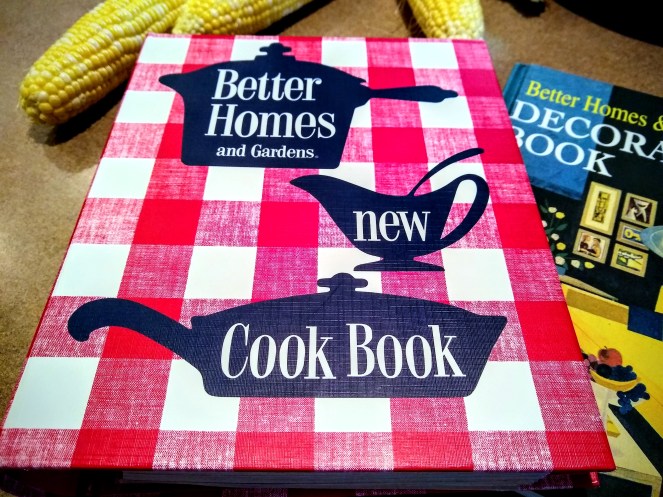
Cooking Lessons: Menu Planning from the 1953 Better Homes and Gardens New Cook Book

I don’t know about you, but as much as I love the endless availability of recipes on the internet, sometimes I like to take a peek inside a traditional cookbook. In particular, those from the heyday of the Home Economics movement in the early 20th century contain some surprisingly handy nuggets.

So, what do they have to offer us now?

One feature that I love about cookbooks of this vintage are the extensive menu planning sections. I think we’ve lost this feature in many modern cookbooks, partly because our ability to buy books has increased and those who like to cook tend to collect many cookbooks (guilty, as charged) rather than just one comprehensive volume. Niche cookbooks tend to eschew menu planning because they stick to only one flavor or type of cuisine. Also, homemaking has been denigrated and women who are solely homemakers are not a majority, so cookbooks have shifted focus to quick meals and visual ideas, rather than systematic, comprehensive kitchen science and planning.

Practical buried treasure

So, what does this meal planning feature look like in the 1953 Better Homes and Gardens New Cook Book?
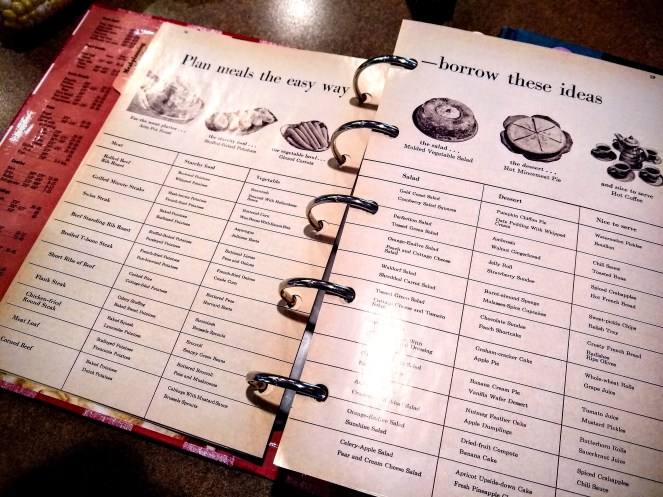
A very clever graph, looking a lot like what we would consider a spreadsheet page. On the left are the main dishes, mostly meat, then the following categories with two options each for starchy foods, vegetables, salad, dessert, and special extras called “nice to serve.”

There are about 18 or so pages of these menu ideas. They cover dinner, lunches, hearty breakfasts, and “oven meals”—where all dishes can be cooked in one oven, meals for large groups, and lunch-box meals. In addition are nutrition guidelines (which continue to have much to offer…i.e. eat your veggies!), food-storage, and directions for meal planning.

Let’s take a for-instance. From the menu spreadsheet, one of the “Meat” options is the familiar standard, Meat Loaf, in the accompanying “Starchy food” options are Scalloped Potatoes or Franconia Potatoes (browned, or roasted). From the “Vegetable” column are Buttered Broccoli and/or Peas and Mushrooms. Next is the “Salad” category, with a choice of Orange-Endive Salad or Sunshine Salad (a gelatine salad with pineapple, carrots and pecans). Finally, “Dessert” offers two options, Dried-fruit Compote or Banana Cake, and the “Nice to serve” column suggests Spiced Crabapples or Chili Sauce (for the meat loaf, presumably).

Nutrition

Here’s where the Home Economics movement hit its scientific peak in meal planning. If we take a look at the “Daily Food Plan” pages in the 1953 BH&G Cook Book we see where our sample meal fits right in. It calls for meat/poultry/fish once daily…so there’s our meatloaf. Next, we have the potatoes/veggies/fruits category, so check mark the potatoes and broccoli and/or peas in our menu plan.
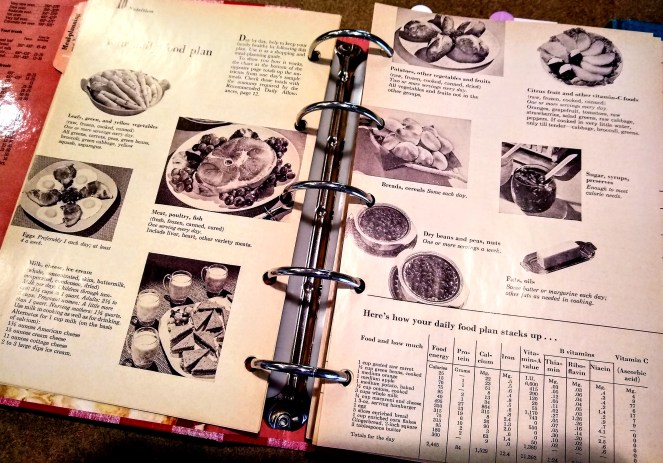
Our Sunshine Salad (remember the carrots and pineapple) and/or the Orange-Endive Salad, easily covers the citrus fruit/other Vitamin-C foods category. The carrots in the Sunshine Salad, and the endive in the Orange-Endive Salad could also cover the leafy/green and yellow vegetables requirement. The desserts will include some dairy, so there’s that, and sugar and oil, check and check. Bonus points for the “regularity” fiber in the Dried-fruit Compote dessert option.

A lot to think about, and somewhat complicated to plan for, which is the genius of the meal planning spreadsheets!

Oh, what a loss when we lost Home Ec

The Home Economics movement began in the last half of the 19th century and was in its stride until the middle of the 20th century, when politics, space-race science, women’s liberation movements, and other policies voided funding for home economics departments in colleges and high schools alike. Which is really a shame because there were brilliant scientific and practical minded women who provided a lot of really fundamental knowledge and disseminated it through the educational system.

If you want to know why there are such things these days as “adulting” classes that teach the most seemingly mundane kitchen and household tasks to those fifty and younger, your answer is that the home economics movement was defunded in the 60’s and 70’s. Otherwise, they would probably have learned those things at school, if not from their parents…. which is another story.

One of the things the home economics movement did best was to make your time in the kitchen efficient, hence the meal planning charts in the 1953 BH&G Cookbook. If you have a spring of ideas at your fingertips, you are more likely to create meals that are both tasty and varied, incorporating a healthy variety of vegetables and fruits as well as various meats, dairy, starches, and other protein sources (as we saw above). With a plan in hand, you don’t have to stress, you can just get on with today’s meals, and your shopping trips will be carefully curated for just the ingredients you need for the week’s meals.

Take a moment and mine your own collection of cookbooks, of a certain vintage, for menu plans. Which ones strike you as being useful today? Which vary in unusual ways from what we think of as typical meals nowadays? Please comment below!

Sources: Better Homes and Gardens New Cook Book, Meredith Publishing Company (reprint), 1953. Better Homes & Gardens New Cook Book: Better Homes and Gardens: 9780696222122: Amazon.com: Books

Recipes

Meatloaf: Versatile Kitchen Standby

I once read that ten basic recipes are the foundation of a cook’s repertoire. With variations, these recipes are the dependable standbys of a weekly menu plan. They take away the repetitious and sometimes draining question: “What should I prepare today?”

Photo: Amanda Stiver

Just like a good restaurant with an enjoyable, but predictable menu, you know what to expect. Novel culinary adventures are fun, but there is also something to be said for the pleasant contentment of predictability, knowing what’s coming and looking forward with anticipation to a familiar and delightful dish.

One dish that fits the bill for the 10-recipe repertoire is meatloaf. It is a jack-of-all-trades recipe that has enough built in flexibility to allow variation without sacrificing form, ie. mushy meatloaf.

Let’s touch on versatility. Prudence in the kitchen expects a recipe to have easy variations. Meatloaf can facilitate this requirement with a variety of spices, or added vegetables, or sauce on top, maybe even cheese as a component. The possibilities are many.

It’s also a multi-purpose dish, and can have a place at breakfast, lunch, or dinner. If ground beef is low, meatloaf can take the form of any ground meat, poultry, or canned fish. Salmon loaf, well executed, is a delicious dinner option.

Meatloaf is also a budget friendly dish. It can be made economical, meat being the most costly ingredient, by cutting down on that component and increasing the oats, crackers, breadcrumbs/cubes, or other starchy carbohydrate component. Also, vegetables can be increased to a degree to make up for a decrease in meat. Beans would be especially effective in this way because they preserve some of the protein content.

Meatloaf in various forms is found in a many cultures. The Scottish have Haggis (using offal-organ meats from sheep, minced, mixed with vegetables and oats and cooked in a sheep’s stomach), in France and England there are dishes like terrine, which may include whole eggs, and whole vegetables layered in the meat, and sometimes the carbohydrate component is included or left out. There are meatballs from the Scandinavian cuisines, and kefta from the Persian/Middle Eastern historical cuisine. The list could go on. Many interesting flavors to explore.

Meatloaf even has cousins, shepherd’s pie, stuffed peppers (or other vegetables), or ground beef pie. Wherever inspiration strikes.

As a recent article I read (see below) made note of, meatloaf became an American culinary staple during the Great Depression of the 1930’s, for many of the reasons listed above. Versatility, economy and stretching a dwindling meat supply due to high prices.  

When you look through your repertoire of recipes, as a prudent consumer, keep an eye out for recipes like meatloaf, that offer ample variety and can save a penny here or there. Cultivating these sometimes humble and predictable recipes gives you economical allies when times are tight!

Please share your meatloaf variations and memories in the comments below or below the Facebook post of this article!

Keep a shiny penny and a positive thought!

Sources: “A History of Meatloaf, Long May It Reign,” by Frank Bruni and Jennifer Steinhauer, March 6, 2017. https://www.bonappetit.com/story/history-of-meatloaf

Consumer Mindset

Oranges into Orangeade: Food Scarcity and the Weak US Citrus Crop

According to a news report on AgDay this morning, the Florida orange crop for the 2022/2023 year is expected to be right around 20 million boxes, that puts this year’s crop about 36% down compared to previous years due to significant hurricane damage. Which is just ahead of another very weak harvest from 85 years ago! The 1937/1938 harvest came in at a mere 19.1 million boxes.

Photo: Amanda Stiver

The report continued by highlighting that with such a hit to the orange crop consumers (that’s us folks) will feel it as a price increase, and additional imports will be required from outside the country to fulfill demand.

That is, and I editorialize here, assuming that crops in other parts of the world are plentiful. Using a worst-case-scenario, let’s touch on an important aspect of having a prudent consumer mindset.

In our hypothetical example of food scarcity, let’s say that oranges (and other citrus crops) aren’t readily available and when they are, they are extremely expensive. What to do? Do we melt into an orange-less sherbet puddle or a look forlornly at our empty glass of breakfast OJ?

No, we do not, because we have that marvelous flexible mindset that all prudent consumers possess. Let’s examine the steps in that process…

  • Step 1: View this scarcity as opportunity and activate creativity under duress!
  • Step 2:Tackle realities. If Oranges, or other citrus fruits, aren’t as readily available, how will that affect our nutrient intake? Specifically, Vitamin-C? What other foods can I find that will make up the difference?
    • Answer: There are many, but cabbage comes to mind. Increase your intake by adjusting your weekly menu accordingly and add more cabbage, brussels sprouts, or broccoli, knowing that to make use of water-soluble Vitamin-C a raw chopped salad or lightly cooked dish is best. This was a trick that the British were encouraged to make use of during the heavily rationed days of WW2, when imported citrus fruits were extremely scarce, often only available to families with children, and victory gardeners were producing plentiful supplies of cabbage in their own back yards.
  • Step 3: Be ingenious. Oranges, but more often lemons, are frequently used as an acid ingredient in recipes. What alternatives can I find that will supply the proper chemical reaction? Another trick from WW2 days, use vinegar (I prefer apple cider) and lemon flavoring for lemon bars, or salad dressings, or as an acid component in a recipe. Buttermilk would also work. Take time to experiment and educate your tastebuds to be adventurous!
  • Step 4: Be constructive with what you do have. Buy what you can afford! That may mean less orange juice or the need to ration oranges, lemons, or grapefruits, so use each individual fruit thoroughly. Enjoy every last bite of the juicy flesh and be sure to eat some of the pithy white stuff, it contains the bioflavonoid Rutin, which helps strengthen blood vessels. Don’t throw out that peel, though! If you need some air freshener, put it down your garbage disposal. Or, do like my great grandmother did and boil grapefruit peels to make quinine which was used to improve various health conditions and stimulate digestion. (If you go down that route, try to use organic produce washed thoroughly and find a reliable recipe, but do so at your own risk.) Also, grate citrus zest before eating the fruit and freeze it to use in recipes later. And that’s just a starter list!

Don’t let food scarcity, or the looming possibility of it, make you feel helpless. You are resourceful and can deal with every eventuality! Take a bit of time to think through each food group and how you could come up with alternatives and ways to stretch what you have.

Let’s pray that the orange supply rebounds and we don’t have to worry about squeezing every last drop of juice from the fruit! But if we must, we’ll know what to do!

Keep a shiny penny and a positive thought!

Sources:

AgDay broadcast for Dec., 13, 2022  https://www.youtube.com/watch?v=vjlM6BwcEXs&list=PLvTM5d7T5l6mwnYBebH2HtRiqlDjhprde