Consumer Mindset

Subconscious Consumer: What Motivates You?

An interesting video was featured today by AgDay (Farm Journal) and PRS IN VIVO, titled “What’s It Like Inside the Mind of a Produce Shopper” (see link under “sources” below). It explored what goes on in the minds of consumers shopping for groceries. I recommend watching the video for more details on the purpose-built “grocery store” in which study volunteers shop wearing special glasses that track their eye movements as they scan the shelves. From their scanning habits experts have drawn conclusions about expectations shoppers have as they view products.

It made me realize that we, too, have access to that kind of study. We’re only a few questions away from understanding what motivates us to buy certain products. The next time you are traversing the grocery store and as you reach for this box-of-that or can-of-this, mentally interview yourself:

Why did I pick this particular product? Was it due to packaging? Placement on the shelf (it was in my eyeline – a coveted piece of real estate that producers pay a lot of money to acquire)? Is it because this brand was a family favorite (mom or grandma always bought it)?

Or are there more pragmatic reasons?

When you finish your purchases and as you check out, look in your cart and ask yourself some of the following questions:

I see that I bought mostly fruits, vegetables and fresh foods (milk, eggs) and dried staple foods (like flour, beans, pasta – the ingredients for home cooked dishes), why did I do that? Was it budget related? Am I trying to cook more at home and pay less for restaurant food, or even buy less processed and pre-made foods? Do I think of myself as health conscious and is this something of which I’ve always been aware? Or have I seen a similar concept recently on Instagram or Facebook, presented as being “good for me”?

If I see a cart of mostly processed foods, why did I choose those items? Is it because I see advertisements that remind me of these comfort foods? Or is it something I saw featured on social media? Am I eating this because I know it to be good for me, or is it an emotional choice?

There are many other questions we can ask ourselves, this is just a sample, but it is a great habit to cultivate as a prudent consumer. Being able to analyze our personal choices and recognize whether we are influenced by advertising, placement, sentiment, or even social media can help us to be more conscious about what we purchase and even save us a few pennies when we recognize a costly, but unnecessary pattern. Needs vs. wants.

Happy shopping!

Sources:

Recipes

Ahoy there! — Almond Flour Chocolate Chip Cookies

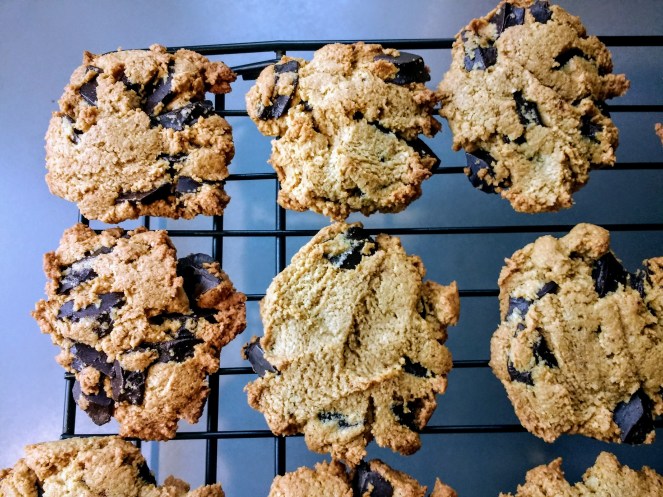
Gluten-free has become a health-protocol for a lot of people. Some because they have serious digestive issues and/or celiac, and others because they want to take a break from the onslaught of gluten in their diet to see if various health issues will improve along with immune system function. This cookie would qualify as gluten-free, but not dairy or egg free.

However, I think (and this is coming from someone who must exclude a lot of things from her diet due to a histamine malfunction called Mast Cell Activation Syndrome—so I know whereof I speak) we can focus on what is not included in a recipe or dish, rather than what is included. And what is there is much more fun than what isn’t there. Abundance mentality vs. deprivation mentality.

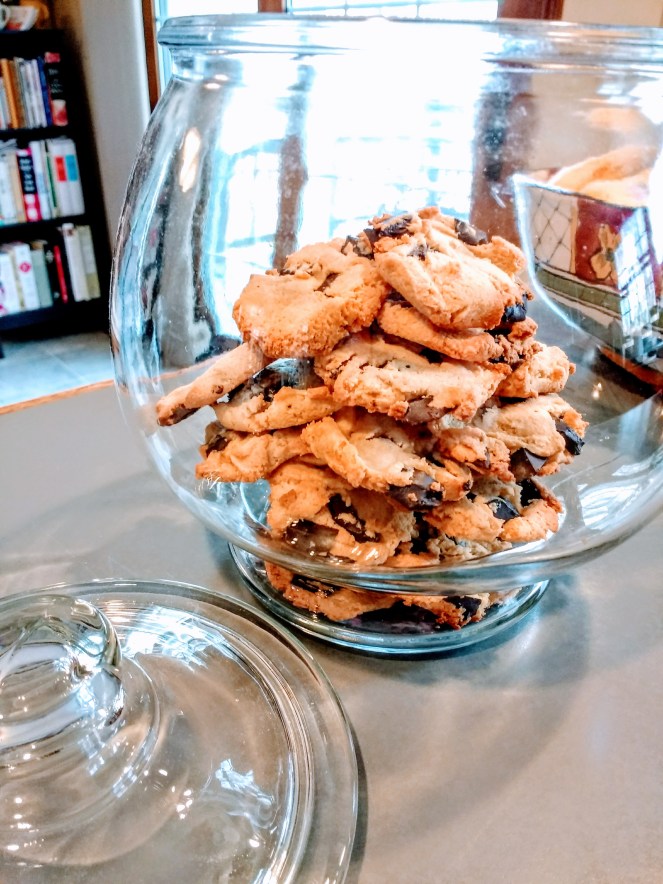
This recipe, which I will link here < Almond Flour Chocolate Chip COOKIE RECIPE > and below, is on the All Recipes website, which is where I found it seven years ago. At our house, we affectionately call it the ‘Chips Ahoy!’ cookie because it has a similar texture and flavor to that well-known cookie product.

Almond flour works well in certain recipes and not so in others. This can be said of most non-gluten flours. They all have their best uses. It’s worth a little investigation and typing up a little cheat-sheet to remind you which ones are best for what purpose.

Almond flour, in this recipe, is a good substitute and produces a nice sturdy, chewy texture that sets off the flavor of the chocolate delightfully.

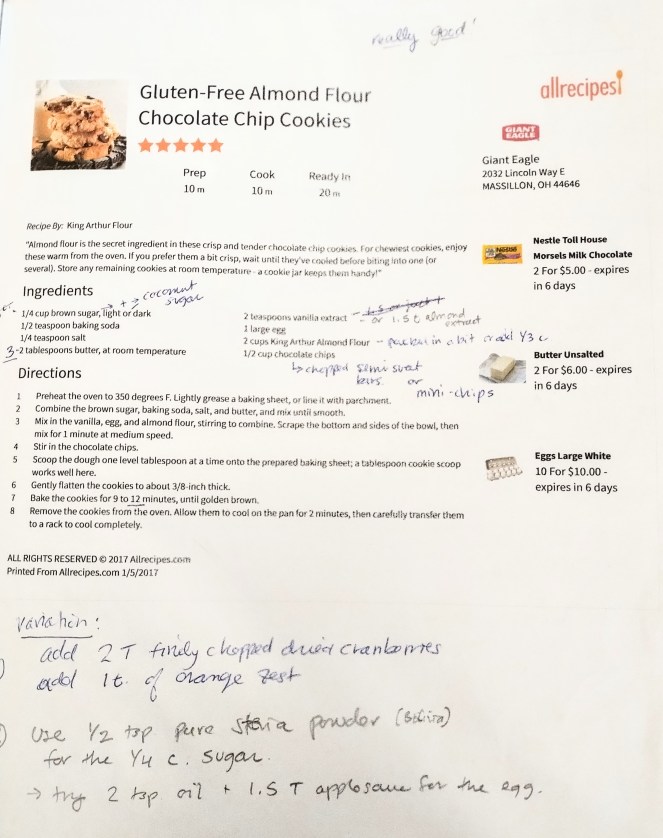
Now, I’m an inveterate recipe tweaker, so I never could leave this one alone and I’ve tried this and that, as you can see in the photo of my much-marked up copy of the recipe. However, using the directions straight from the original produces a fantastic cookie, so start there and then tweak as you like.

If you want to tweak right away, I’d suggest using (in place of the chocolate chips) 4 oz. of good quality bittersweet chocolate bar that you chop up with a sharp chef’s knife into little pieces. That way you get bits of chocolate spread out into more of the cookie dough.

Reminder: when you begin to scoop the dough onto a cookie sheet, gently flatten the cookies, as it says in the recipe, otherwise you get almond flour haystacks and the final product won’t have as even a texture.

Even if you don’t need to avoid gluten, this makes a fun cookie to rotate with wheat-flour variations. Almond flour has a long history as a confection and ingredient in candies, cookies and cakes, so as you enjoy each bite, take a moment to imagine all the other historical cookie snackers over time who have indulged in the delights of almond flour! And smile at your budget as it thanks you for making a recipe from scratch that can taste just as good as the store-bought, commercially processed varieties!

Sources: Gluten-Free Almond Flour Chocolate Chip Cookies, at AllRecipes.com by King Arthur Flour, Jan. 20, 2022. Gluten-Free Almond Flour Chocolate Chip Cookies (allrecipes.com)

Old School Skills

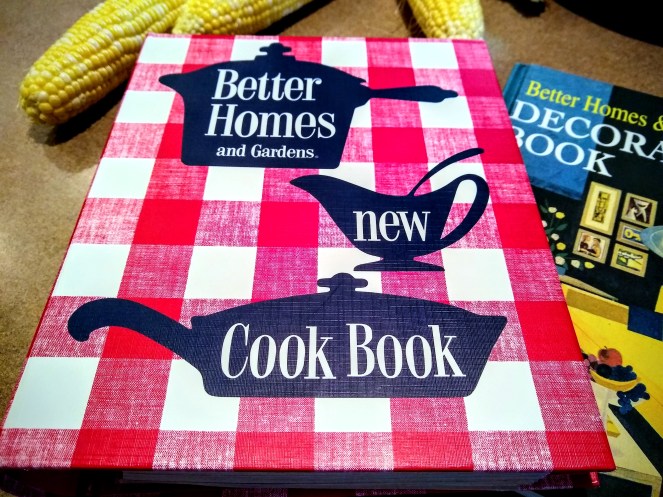
Cooking Lessons: Menu Planning from the 1953 Better Homes and Gardens New Cook Book

I don’t know about you, but as much as I love the endless availability of recipes on the internet, sometimes I like to take a peek inside a traditional cookbook. In particular, those from the heyday of the Home Economics movement in the early 20th century contain some surprisingly handy nuggets.

So, what do they have to offer us now?

One feature that I love about cookbooks of this vintage are the extensive menu planning sections. I think we’ve lost this feature in many modern cookbooks, partly because our ability to buy books has increased and those who like to cook tend to collect many cookbooks (guilty, as charged) rather than just one comprehensive volume. Niche cookbooks tend to eschew menu planning because they stick to only one flavor or type of cuisine. Also, homemaking has been denigrated and women who are solely homemakers are not a majority, so cookbooks have shifted focus to quick meals and visual ideas, rather than systematic, comprehensive kitchen science and planning.

Practical buried treasure

So, what does this meal planning feature look like in the 1953 Better Homes and Gardens New Cook Book?

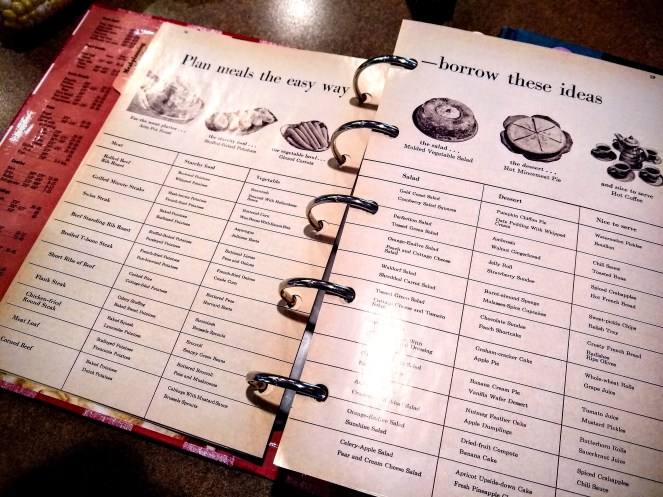
A very clever graph, looking a lot like what we would consider a spreadsheet page. On the left are the main dishes, mostly meat, then the following categories with two options each for starchy foods, vegetables, salad, dessert, and special extras called “nice to serve.”

There are about 18 or so pages of these menu ideas. They cover dinner, lunches, hearty breakfasts, and “oven meals”—where all dishes can be cooked in one oven, meals for large groups, and lunch-box meals. In addition are nutrition guidelines (which continue to have much to offer…i.e. eat your veggies!), food-storage, and directions for meal planning.

Let’s take a for-instance. From the menu spreadsheet, one of the “Meat” options is the familiar standard, Meat Loaf, in the accompanying “Starchy food” options are Scalloped Potatoes or Franconia Potatoes (browned, or roasted). From the “Vegetable” column are Buttered Broccoli and/or Peas and Mushrooms. Next is the “Salad” category, with a choice of Orange-Endive Salad or Sunshine Salad (a gelatine salad with pineapple, carrots and pecans). Finally, “Dessert” offers two options, Dried-fruit Compote or Banana Cake, and the “Nice to serve” column suggests Spiced Crabapples or Chili Sauce (for the meat loaf, presumably).

Nutrition

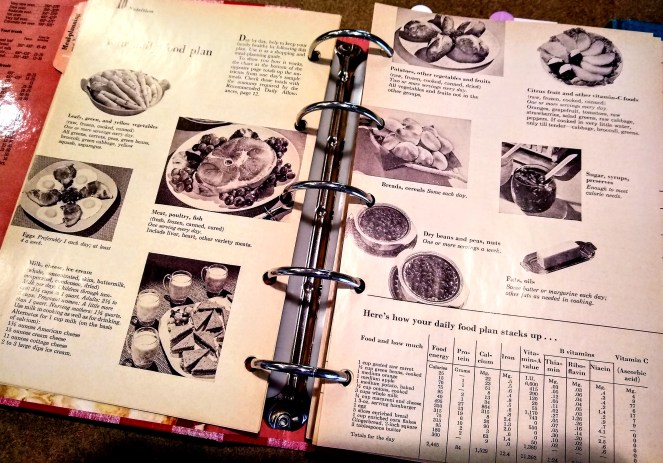
Here’s where the Home Economics movement hit its scientific peak in meal planning. If we take a look at the “Daily Food Plan” pages in the 1953 BH&G Cook Book we see where our sample meal fits right in. It calls for meat/poultry/fish once daily…so there’s our meatloaf. Next, we have the potatoes/veggies/fruits category, so check mark the potatoes and broccoli and/or peas in our menu plan.

Our Sunshine Salad (remember the carrots and pineapple) and/or the Orange-Endive Salad, easily covers the citrus fruit/other Vitamin-C foods category. The carrots in the Sunshine Salad, and the endive in the Orange-Endive Salad could also cover the leafy/green and yellow vegetables requirement. The desserts will include some dairy, so there’s that, and sugar and oil, check and check. Bonus points for the “regularity” fiber in the Dried-fruit Compote dessert option.

A lot to think about, and somewhat complicated to plan for, which is the genius of the meal planning spreadsheets!

Oh, what a loss when we lost Home Ec

The Home Economics movement began in the last half of the 19th century and was in its stride until the middle of the 20th century, when politics, space-race science, women’s liberation movements, and other policies voided funding for home economics departments in colleges and high schools alike. Which is really a shame because there were brilliant scientific and practical minded women who provided a lot of really fundamental knowledge and disseminated it through the educational system.

If you want to know why there are such things these days as “adulting” classes that teach the most seemingly mundane kitchen and household tasks to those fifty and younger, your answer is that the home economics movement was defunded in the 60’s and 70’s. Otherwise, they would probably have learned those things at school, if not from their parents…. which is another story.

One of the things the home economics movement did best was to make your time in the kitchen efficient, hence the meal planning charts in the 1953 BH&G Cookbook. If you have a spring of ideas at your fingertips, you are more likely to create meals that are both tasty and varied, incorporating a healthy variety of vegetables and fruits as well as various meats, dairy, starches, and other protein sources (as we saw above). With a plan in hand, you don’t have to stress, you can just get on with today’s meals, and your shopping trips will be carefully curated for just the ingredients you need for the week’s meals.

Take a moment and mine your own collection of cookbooks, of a certain vintage, for menu plans. Which ones strike you as being useful today? Which vary in unusual ways from what we think of as typical meals nowadays? Please comment below!

Sources: Better Homes and Gardens New Cook Book, Meredith Publishing Company (reprint), 1953. Better Homes & Gardens New Cook Book: Better Homes and Gardens: 9780696222122: Amazon.com: Books

Recipes

Abelskivers : Travel by Recipe

(I am an Amazon Associate and as such I earn a small commission from any qualifying purchases that are linked below.)

Sometimes we underestimate the value of a stovetop. Did you know that it can substitute for a jet aircraft?

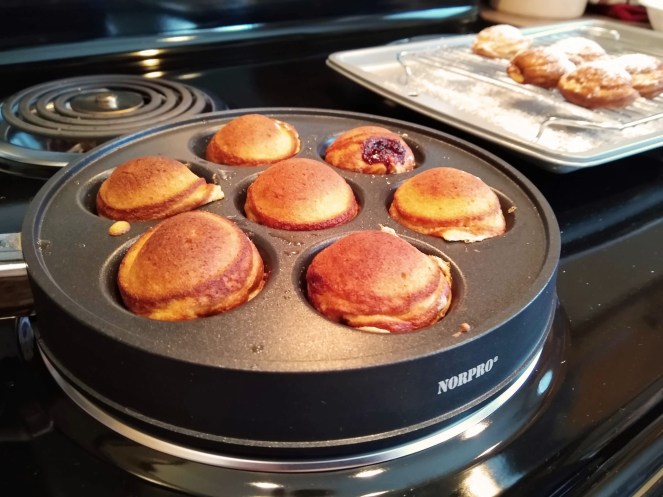
Abelskivers ready to eat!
Photo: Amanda Stiver

No, this isn’t some crazy do-it-yourself-transformation project a la Red Green, with the help of a little duct-tape. But, in fact, you can travel by stove-top, or more accurately travel by recipe.

Exploring the history and cultures of the world is high on the “bucket” list for many people, but low (or no) budget travelers have to fulfill the ambitions and imaginations of our hearts by re-thinking global exploration.

Oftentimes, on a trip to a new culture or location one of the resounding experiences that fills our memory is the unique, flavorful and unfamiliar foods that we encounter. The scents and textures, flavors and colors of that culture come to us through the sips and bites we take while visiting.

Would Paris be as romantic if they served Kellogg’s Cornflakes and instant coffee instead of freshly pressed café au lait and croissant? Certainly, it would diminish the romance.

Would a visit to Israel be as redolent of its biblical heritage if you substituted steak and potatoes (though delicious in their own right) for the multitudinous fresh vegetables, salads, and meat dishes spiced with the historical herbs and spices of the Mediterranean world that have come to be so closely associated with that place? I dare say not.

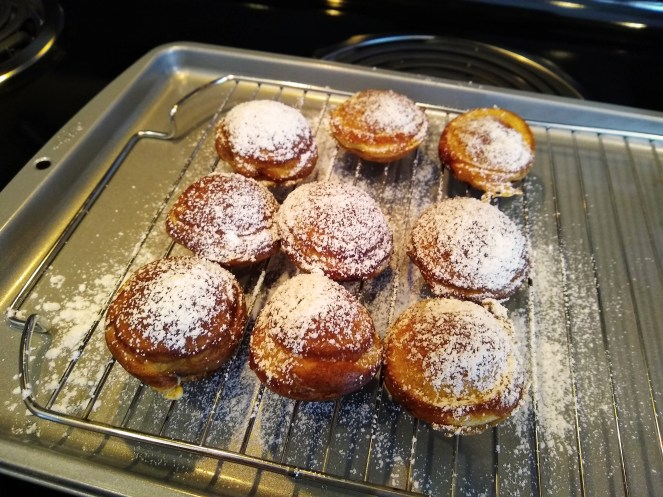
Finish with a dusting of powdered sugar.
Photo: Amanda Stiver

Yet, the recipes of both places can be replicated in your own kitchen…

My chosen destination turned out to be Denmark via a dish also shared with Scandinavia and North Germany. And my vehicle? Abelskivers! A puffy, round sweet pastry that tastes much like a pancake. Some recipes use yeast and others using baking powder as the leavening agent. They may or may not be filled with jam (we tried both raspberry and orange marmalade) or Nutella, and the final product is served lightly dusted with powdered sugar.

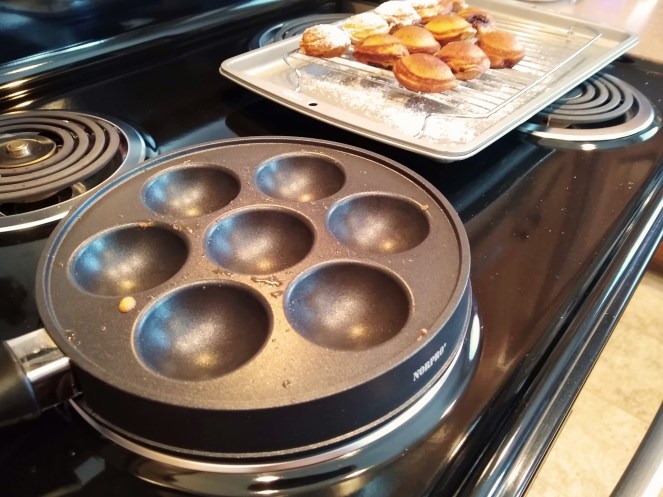
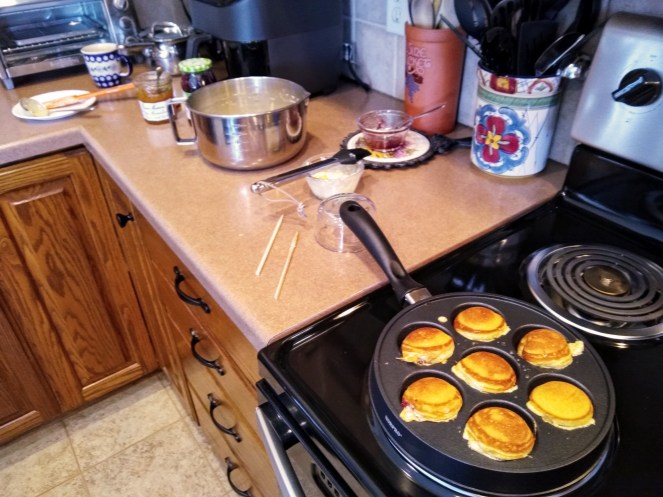
Each hole is filled half-way with batter, then as they cook, you turn them by quarter-turns till fully cooked.
Photo: Amanda Stiver

I’ve made them twice so far. Once as a dessert. And the other as a brunch pastry. Both were tasty and there is a peculiar urge to gobble every one in sight, partly because they are so cute.

To tackle this recipe you will need a specialized pan, there is no way around that. It’s a circular pan with round half-circles molded in (these you fill with batter). I chose a non-stick variety so as to avoid hassling with clean-up.

Photo: Amanda Stiver

My pick was the Norpro brand that I found on Amazon. It is sturdy cast aluminum, and I’ve used it for two batches thus far and it works very well and is quite substantial. Some other brands are more hefty and a bit pricier, but this one is solid and easy to clean. If you are looking for your own pan, here it is: https://amzn.to/3XKG1Gv  (This is a paid link – I’m an amazon affiliate and get a small commission if anyone makes a purchase through this link.)

It does take some technique and a long wooden skewer is essential for carefully turning the batter as it cooks, quarter-turns create a nice round ball. If you make mistakes, remember, they are still edible! Just eat the evidence!

My cooking station in action. Ingredients read to go, including wooden skewers for turning.
Photo: Amanda Stiver

I’ve included a couple of recipe variations below. I have tried the first one, and found I liked it best, it uses baking powder as a leavening agent. I have not tried the second, but it is similar to one I did try and it uses yeast and is quite rich, best for when you have lots of people to share it with, just in case you’re tempted to eat too many.

Recipes:

“Ebelskivers (Danish Pancakes) With Lingonberry Jam Recipe” by Carrie Vasios Mullins, June 2, 2020. https://www.seriouseats.com/ebelskivers-danish-pancakes-lingonberry-jam-recipe

“North German Pancake Balls” by germanfoods. https://germanfoods.org/recipes/north-german-pancake-balls/

Old School Skills

Wielding A Wise Saying: Breaking Eggs!

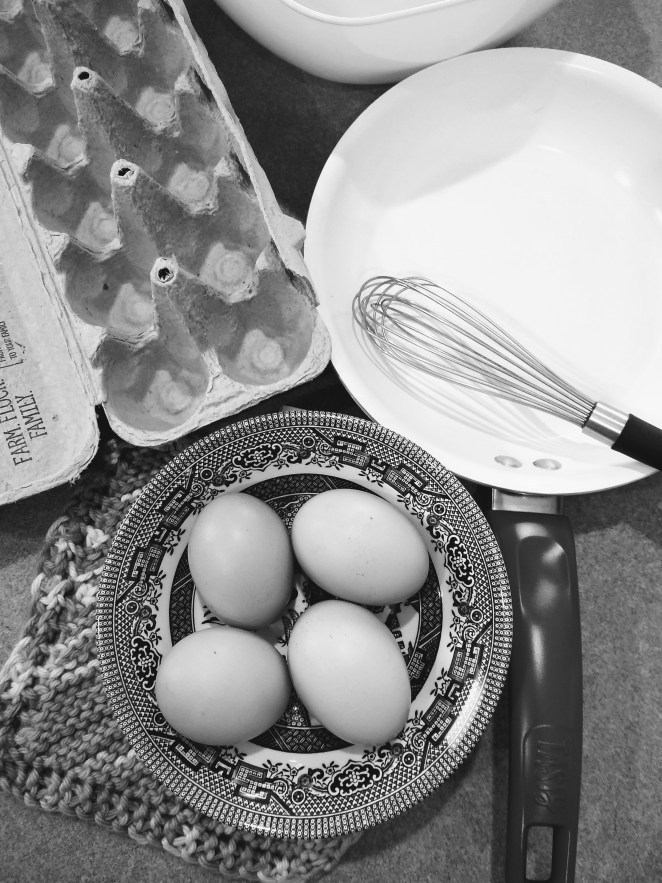
“You can’t make an omelet without breaking a few eggs!”

Photo: Amanda Stiver

In our current economic climate, and considering the price of eggs right now, the above saying might seem like heresy, but it’s still true!

I don’t know about you, but I love old sayings like these. They used to be the pepper and spice of everyday speech, but because of the over-saturation of social media, and the ever increasing gap in numbers between those who live an agrarian based lifestyle and those who don’t, we’ve lost many of them.

I’ve heard it argued that such sayings are trite and common, hopelessly outdated, repetitive, and (greatest of all insults) “not authentic.” Of course, this advice came from the same individuals, some of my college professors, who perpetuated the lofty sounding phrases of “academese” at length and often. A case of “people in glass houses who aught not throw stones,” to coin a phrase.

Both my maternal and paternal grandparents were fonts of pithy sayings like these. “Many hands make light work” and “for every old sock there’s an old shoe” being two that were oft-repeated. Each of these useful nuggets encapsulated a practical or eternal truth. And, with semi-poetic phrasing, they caught themselves in the memory and surfaced when needed.

The book of Proverbs in the Bible is a tremendous repository of such wise sayings (though of more spiritual value and emphasis), and other cultures feature proverbs and sayings as well. Proverbial sayings have carried-over from times when oral cultures were the norm, books being costly and few and far between, but they are also a convenient “life-hack.” With a cheerful dose of humor, they can help put things in perspective when we are tempted to succumb to the over-dramatic and lose all sense of proportion.

And that gets us back to “You can’t make an omelet without breaking a few eggs.” This great saying means that (despite the ridiculously high cost of eggs) in order to do something right, there will probably be some mess, and stress, and some collateral damage, but in the end, that trail of dust or clippings or drippings means that something productive has been achieved. Maybe even something delicious!

It can also mean that a little outlay (often money) is required if you want to get something important done. Think a nest egg that allows you to fund a project that in turn might prove to be a source of income or of great help to others.

We could go on, but you can see the wisdom all tied up in that tidy, but descriptive saying. You’ll never see an egg, or an omelet, again without thinking of this bit of instruction!

What are some of your favorite “wise-sayings” or “things that grandma always said?” Let us know in the comments below, or in the comments section on Facebook when you see this post.

Keep a shiny penny and a positive thought!

Sources: “63 Sayings You Learned From Your Southern Grandma” by Southern Living editors, May 21, 2019. https://www.southernliving.com/culture/southern-grandma-sayings

Consumer Mindset

Oranges into Orangeade: Food Scarcity and the Weak US Citrus Crop

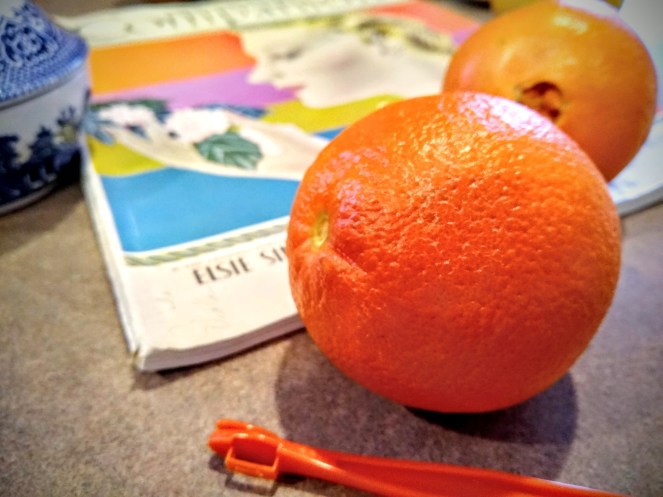
According to a news report on AgDay this morning, the Florida orange crop for the 2022/2023 year is expected to be right around 20 million boxes, that puts this year’s crop about 36% down compared to previous years due to significant hurricane damage. Which is just ahead of another very weak harvest from 85 years ago! The 1937/1938 harvest came in at a mere 19.1 million boxes.

Photo: Amanda Stiver

The report continued by highlighting that with such a hit to the orange crop consumers (that’s us folks) will feel it as a price increase, and additional imports will be required from outside the country to fulfill demand.

That is, and I editorialize here, assuming that crops in other parts of the world are plentiful. Using a worst-case-scenario, let’s touch on an important aspect of having a prudent consumer mindset.

In our hypothetical example of food scarcity, let’s say that oranges (and other citrus crops) aren’t readily available and when they are, they are extremely expensive. What to do? Do we melt into an orange-less sherbet puddle or a look forlornly at our empty glass of breakfast OJ?

No, we do not, because we have that marvelous flexible mindset that all prudent consumers possess. Let’s examine the steps in that process…

  • Step 1: View this scarcity as opportunity and activate creativity under duress!
  • Step 2:Tackle realities. If Oranges, or other citrus fruits, aren’t as readily available, how will that affect our nutrient intake? Specifically, Vitamin-C? What other foods can I find that will make up the difference?
    • Answer: There are many, but cabbage comes to mind. Increase your intake by adjusting your weekly menu accordingly and add more cabbage, brussels sprouts, or broccoli, knowing that to make use of water-soluble Vitamin-C a raw chopped salad or lightly cooked dish is best. This was a trick that the British were encouraged to make use of during the heavily rationed days of WW2, when imported citrus fruits were extremely scarce, often only available to families with children, and victory gardeners were producing plentiful supplies of cabbage in their own back yards.
  • Step 3: Be ingenious. Oranges, but more often lemons, are frequently used as an acid ingredient in recipes. What alternatives can I find that will supply the proper chemical reaction? Another trick from WW2 days, use vinegar (I prefer apple cider) and lemon flavoring for lemon bars, or salad dressings, or as an acid component in a recipe. Buttermilk would also work. Take time to experiment and educate your tastebuds to be adventurous!
  • Step 4: Be constructive with what you do have. Buy what you can afford! That may mean less orange juice or the need to ration oranges, lemons, or grapefruits, so use each individual fruit thoroughly. Enjoy every last bite of the juicy flesh and be sure to eat some of the pithy white stuff, it contains the bioflavonoid Rutin, which helps strengthen blood vessels. Don’t throw out that peel, though! If you need some air freshener, put it down your garbage disposal. Or, do like my great grandmother did and boil grapefruit peels to make quinine which was used to improve various health conditions and stimulate digestion. (If you go down that route, try to use organic produce washed thoroughly and find a reliable recipe, but do so at your own risk.) Also, grate citrus zest before eating the fruit and freeze it to use in recipes later. And that’s just a starter list!

Don’t let food scarcity, or the looming possibility of it, make you feel helpless. You are resourceful and can deal with every eventuality! Take a bit of time to think through each food group and how you could come up with alternatives and ways to stretch what you have.

Let’s pray that the orange supply rebounds and we don’t have to worry about squeezing every last drop of juice from the fruit! But if we must, we’ll know what to do!

Keep a shiny penny and a positive thought!

Sources:

AgDay broadcast for Dec., 13, 2022  https://www.youtube.com/watch?v=vjlM6BwcEXs&list=PLvTM5d7T5l6mwnYBebH2HtRiqlDjhprde