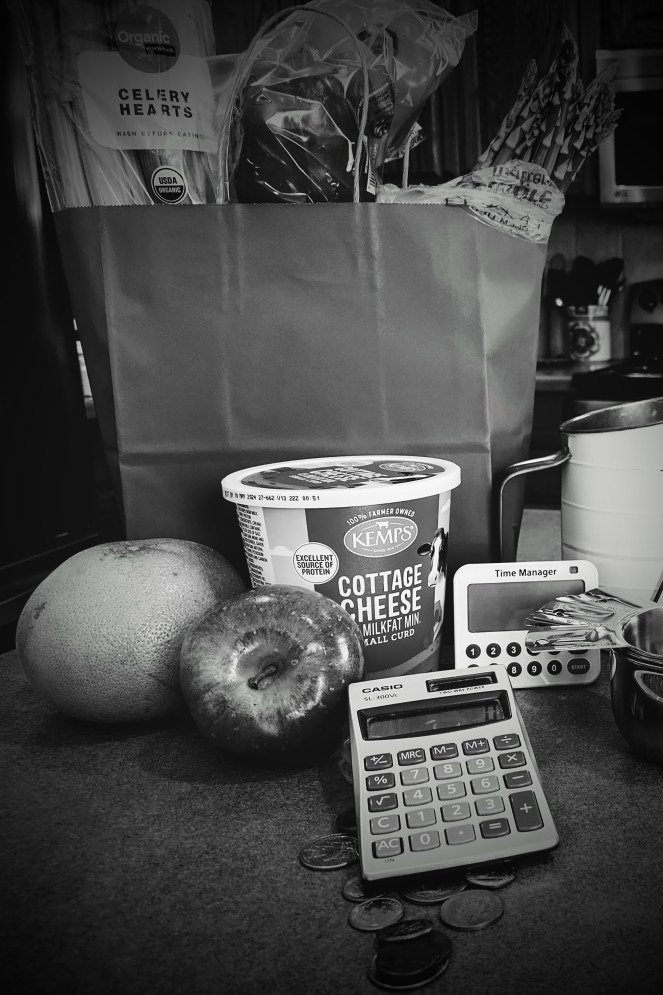
Consumer Mindset

Subconscious Consumer: What Motivates You?

An interesting video was featured today by AgDay (Farm Journal) and PRS IN VIVO, titled “What’s It Like Inside the Mind of a Produce Shopper” (see link under “sources” below). It explored what goes on in the minds of consumers shopping for groceries. I recommend watching the video for more details on the purpose-built “grocery store” in which study volunteers shop wearing special glasses that track their eye movements as they scan the shelves. From their scanning habits experts have drawn conclusions about expectations shoppers have as they view products.

It made me realize that we, too, have access to that kind of study. We’re only a few questions away from understanding what motivates us to buy certain products. The next time you are traversing the grocery store and as you reach for this box-of-that or can-of-this, mentally interview yourself:

Why did I pick this particular product? Was it due to packaging? Placement on the shelf (it was in my eyeline – a coveted piece of real estate that producers pay a lot of money to acquire)? Is it because this brand was a family favorite (mom or grandma always bought it)?

Or are there more pragmatic reasons?

When you finish your purchases and as you check out, look in your cart and ask yourself some of the following questions:

I see that I bought mostly fruits, vegetables and fresh foods (milk, eggs) and dried staple foods (like flour, beans, pasta – the ingredients for home cooked dishes), why did I do that? Was it budget related? Am I trying to cook more at home and pay less for restaurant food, or even buy less processed and pre-made foods? Do I think of myself as health conscious and is this something of which I’ve always been aware? Or have I seen a similar concept recently on Instagram or Facebook, presented as being “good for me”?

If I see a cart of mostly processed foods, why did I choose those items? Is it because I see advertisements that remind me of these comfort foods? Or is it something I saw featured on social media? Am I eating this because I know it to be good for me, or is it an emotional choice?

There are many other questions we can ask ourselves, this is just a sample, but it is a great habit to cultivate as a prudent consumer. Being able to analyze our personal choices and recognize whether we are influenced by advertising, placement, sentiment, or even social media can help us to be more conscious about what we purchase and even save us a few pennies when we recognize a costly, but unnecessary pattern. Needs vs. wants.

Happy shopping!

Sources:

Consumer Mindset · Old School Skills

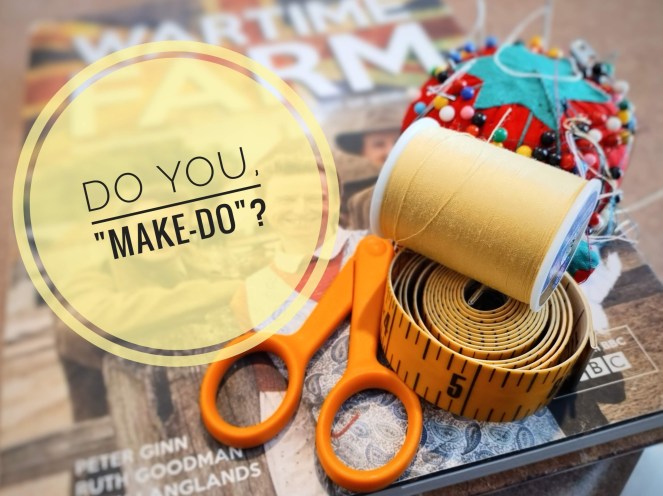
Are You “Making-Do”? – The Wartime Farm – BBC 2012

For the second time in several years, I’m re-watching the Wartime Farm, a BBC production from 2012. It follows the adventures of a team of three: historian Ruth Goodman, and archeologists Peter Ginn and Alex Langlands, as they recreate the conditions of a farm during World War Two, 1939-1945, in Britain. It is filmed on the beautiful Manor Farm, an historical park that has preserved much of late 1930s and early 40s living space and agriculture.  

I’m always drawn to these historical recreations. A genre that became popular back in the late 1990s with the Victorian House and the 1940s House (my favorite), among other historical, time-travel “reality” shows. Though in some productions the internal drama of the participants predominated, the Wartime Farm definitely does not do so (and neither did the 1940s House for that matter, much to the credit of those participating).

Tough times can produce sterling qualities

My own college research was in the WW2 era, and I have been and remain fascinated with that time when so much was on the line. We live in a similar period, though cocooned in our material plenty, we often do not recognize that fact. My own grandparents spent their teen and young adult years navigating the Great Depression and the Second World War. It left an indelible impression on their lives and lifestyles. My maternal grandparents had a Victory-style garden nearly their whole lives, though, to be fair, they had grown up the children of homesteaders, so their subsistence lifestyle predates the 30s and 40s.

There was a great pulling-together and spirit of self-sacrifice, which ultimately showed many people that they were made of tougher stuff than they had assumed. There was strength in shared purpose, and the dangers of invasion and occupation brought on a sobriety that had been lost in the excesses of the 1920s.

Aside from the greater moral lessons of the war, what I really found practical from a Prudent Consumer perspective, is the concept of “making-do” that predominated WW2 government and popular, practical literature, and a principle featured in the Wartime Farm series. This was especially so for Britain, where, as an island, they were subject to greater privations than in the U.S. Making do with what you had before the war had to carry you through to the end of it (whenever that was), or until intrepid merchant boats could get through the German blockade at sea.

Old lessons, new applications

We’re feeling a bit of this now in the U.S., with increased interest rates and the need for new trade negotiations. A dynamic that is always rough seas at first until fruitful negotiations produce a fair reciprocity in international trade. Could we end up without the flow of endless material goods from China? Or at least a slower flow? Might we have to wait on U.S. production to ramp up and then pay a bit more for, one hopes, better quality? Possibly.

In either case, the premise of “make-do and mend” or “use what you have and repair items that you might otherwise have thrown out” were hallmarks of both the Great Depression and WW2. They served people well then, and can do so now.

Three takeaway principles

A framework for applying a “make-do and mend” mentality:

  1. Think before you spend. Ask the simple question: do I already have something that will serve the same purpose as the item I want to buy? If I do, and it needs a bit of mending or repair, can I accomplish that? If not, do I know someone who can? Can I learn the repair skill from YouTube or another person?
  2. Singularize, don’t duplicate. If you have an item in one color (aside from t-shirts), do you need the same thing in five tonally harmonizing hues? No, buy the neutral one first and it will match with more things.
  3. Learn the difference between “wants” and “needs.” You might also hear these referred to as “extras” and “basics.” You can get by on basics, groceries or otherwise, but you will become wasteful if you always purchase extras. You’ll also accrue debt.

I’m sure you can think of many other applications of “make-do and mend,” and it’s a great mental exercise to practice.

And remember, it can also apply to technology! If you’re feeling overwhelmed by the constant barrage of social media, you can “make-do” with less by cutting back on the sites and apps you participate in. Delete all but the most “basic” apps from your phone screen and notice how much less you feel tied to your device.

Let me know of any additional “make-do” ideas you’ve developed in the comments section!

Sources:

Wartime Farm: Rediscovering the Skills and Spirit of World War II, Peter Ginn, Ruth Goodman, Alex Langlands, Mitchell Beazley publishers, 2012.

Wartime Farm is presently streaming for free on Tubi, as of February 2025.

    Consumer Mindset

    Oranges into Orangeade: Food Scarcity and the Weak US Citrus Crop

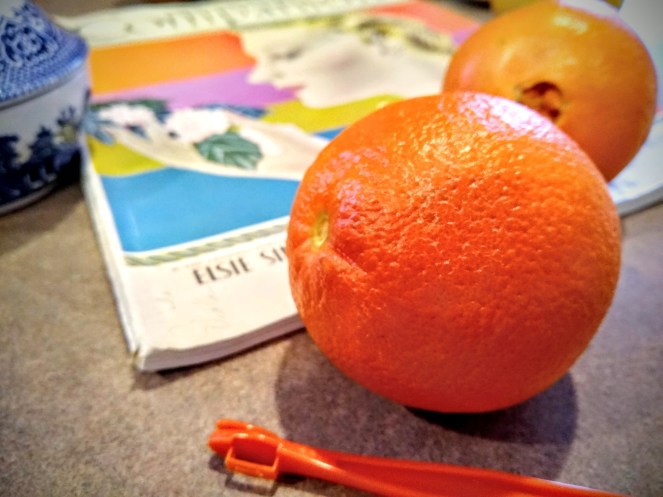
    According to a news report on AgDay this morning, the Florida orange crop for the 2022/2023 year is expected to be right around 20 million boxes, that puts this year’s crop about 36% down compared to previous years due to significant hurricane damage. Which is just ahead of another very weak harvest from 85 years ago! The 1937/1938 harvest came in at a mere 19.1 million boxes.

    Photo: Amanda Stiver

    The report continued by highlighting that with such a hit to the orange crop consumers (that’s us folks) will feel it as a price increase, and additional imports will be required from outside the country to fulfill demand.

    That is, and I editorialize here, assuming that crops in other parts of the world are plentiful. Using a worst-case-scenario, let’s touch on an important aspect of having a prudent consumer mindset.

    In our hypothetical example of food scarcity, let’s say that oranges (and other citrus crops) aren’t readily available and when they are, they are extremely expensive. What to do? Do we melt into an orange-less sherbet puddle or a look forlornly at our empty glass of breakfast OJ?

    No, we do not, because we have that marvelous flexible mindset that all prudent consumers possess. Let’s examine the steps in that process…

    • Step 1: View this scarcity as opportunity and activate creativity under duress!
    • Step 2:Tackle realities. If Oranges, or other citrus fruits, aren’t as readily available, how will that affect our nutrient intake? Specifically, Vitamin-C? What other foods can I find that will make up the difference?
      • Answer: There are many, but cabbage comes to mind. Increase your intake by adjusting your weekly menu accordingly and add more cabbage, brussels sprouts, or broccoli, knowing that to make use of water-soluble Vitamin-C a raw chopped salad or lightly cooked dish is best. This was a trick that the British were encouraged to make use of during the heavily rationed days of WW2, when imported citrus fruits were extremely scarce, often only available to families with children, and victory gardeners were producing plentiful supplies of cabbage in their own back yards.
    • Step 3: Be ingenious. Oranges, but more often lemons, are frequently used as an acid ingredient in recipes. What alternatives can I find that will supply the proper chemical reaction? Another trick from WW2 days, use vinegar (I prefer apple cider) and lemon flavoring for lemon bars, or salad dressings, or as an acid component in a recipe. Buttermilk would also work. Take time to experiment and educate your tastebuds to be adventurous!
    • Step 4: Be constructive with what you do have. Buy what you can afford! That may mean less orange juice or the need to ration oranges, lemons, or grapefruits, so use each individual fruit thoroughly. Enjoy every last bite of the juicy flesh and be sure to eat some of the pithy white stuff, it contains the bioflavonoid Rutin, which helps strengthen blood vessels. Don’t throw out that peel, though! If you need some air freshener, put it down your garbage disposal. Or, do like my great grandmother did and boil grapefruit peels to make quinine which was used to improve various health conditions and stimulate digestion. (If you go down that route, try to use organic produce washed thoroughly and find a reliable recipe, but do so at your own risk.) Also, grate citrus zest before eating the fruit and freeze it to use in recipes later. And that’s just a starter list!

    Don’t let food scarcity, or the looming possibility of it, make you feel helpless. You are resourceful and can deal with every eventuality! Take a bit of time to think through each food group and how you could come up with alternatives and ways to stretch what you have.

    Let’s pray that the orange supply rebounds and we don’t have to worry about squeezing every last drop of juice from the fruit! But if we must, we’ll know what to do!

    Keep a shiny penny and a positive thought!

    Sources:

    AgDay broadcast for Dec., 13, 2022  https://www.youtube.com/watch?v=vjlM6BwcEXs&list=PLvTM5d7T5l6mwnYBebH2HtRiqlDjhprde

    Consumer Mindset

    What Is a “Prudent Consumer”?

    Photo: Amanda Stiver

    Do you feel like you’re in the passenger seat when you go to the store, in person or online? Do groceries jump into your cart because you’re desperately out of time to shop and prepare a meal? Or because you or someone with you is extremely hungry, bordering on hangry? Or because the products you see on your Facebook feed or other social media seem like a good idea and it’s the most recent thing you could remember because, once again, you didn’t have much of a shopping list (or too much of a shopping list if you’re on Amazon)? Or worse, are you struggling with a limited budget and feeling hemmed in by prices and lack of ideas?

    Good! Because now we know where to start. Wearing the shoes of every grumpy, frustrated, out of time, and over-budget frazzled shopper is the start of a prudent consumer. It just takes a little time and good advice to put the frazzled shopper down for a nap and give the prudent consumer time to shine.

    Join us as we tackle the process, ours and yours, of being a prudent consumer in an age of economic volatility, over-invasive digital marketing, and a vacancy in the “old-time common sense” department. We aren’t facing anything that hasn’t been faced in the past, the window-dressing may be different, but the basic human frustrations aren’t.

    Our parents and great-grandparents (mom and daughter duo here) were hit head-on by the Great Depression of the 1930’s followed quickly by World War Two rations and privations, but they soldiered on because of a solid education in consumer prudence and an abhorrence of waste. We live in an age that seems consumed by two things, a need for constant material increase (stuff, we call it) and yet a looming fear that they are grossly polluting the planet. Without getting into the economics and ecology debate, developing a strong disgust for “wastefulness” is a good foundation point for being a prudent, rather than a flippant or wasteful consumer.

    With a pocketful of “prudent consumer” tools you can win the battle of the dwindling wallet and be in control and content with what you need rather than being manipulated by your wants or whims! Join us on this adventure, and share your own prudent consumer tips in the comments as we go along. Together we’ll build a team of prudent consumers who can share their skills and help others along the same path toward a more stable financial future.

    Keep a shiny penny and a positive thought!